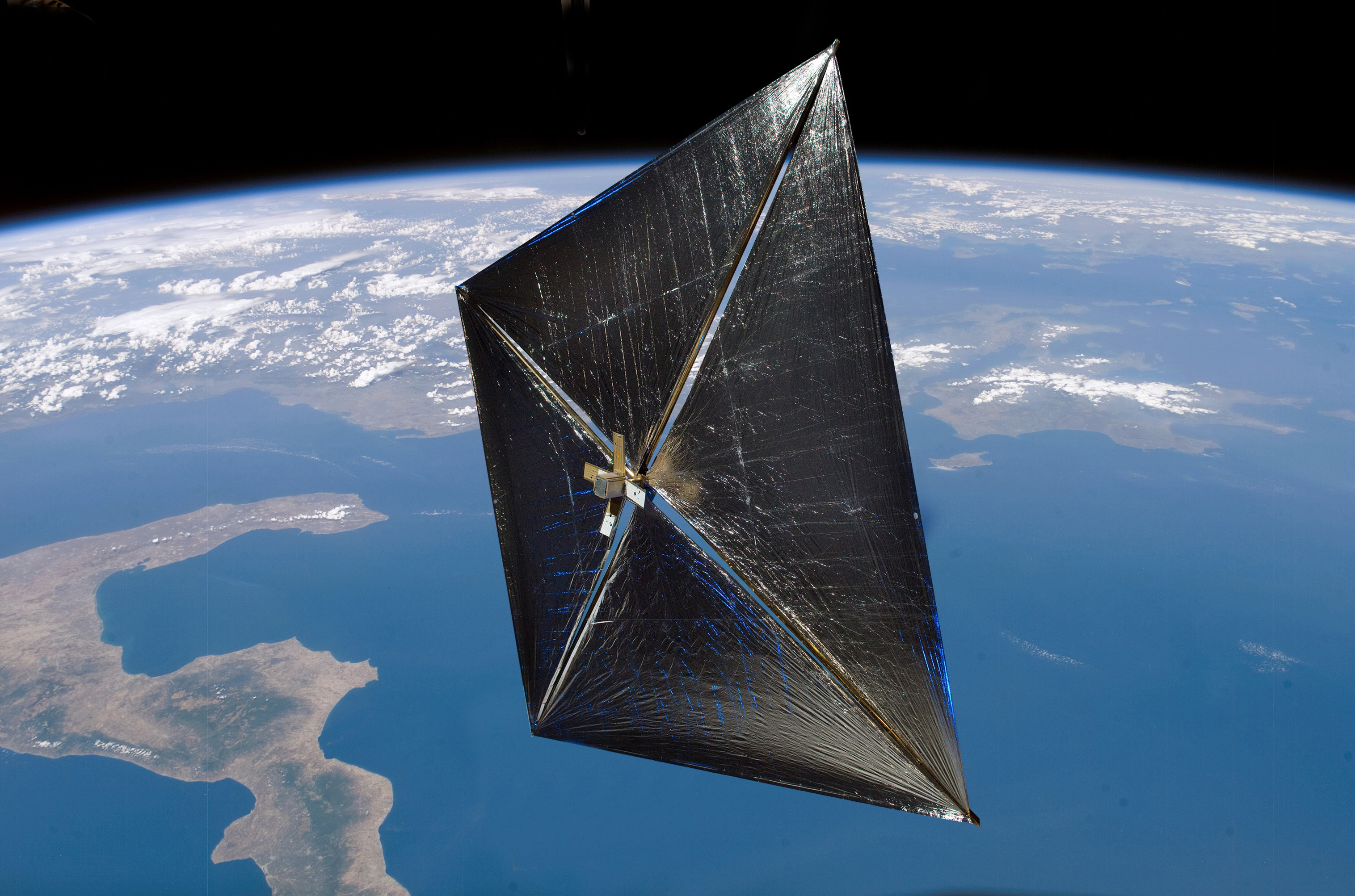
The idea of solar sails has actually been around for a very long time- famous astronomer Joseph Kepler proposed the idea in the 1600’s after observing how sunlight scattered the dust around comets to form their tails. It wasn’t until the 1950’s that the idea truly took hold, though. Several propositions have been made, but they all have a similar designs. Using an incredibly thin mirror-like sail, a satellite could use the energy of the sun’s photons bouncing off of it to propel itself around the solar system. Aside from the motors needed to adjust the sail’s position, no on board propulsion systems would be needed at all.
Solar sails provide some good advantages over other propulsion methods. Since they aren’t required to carry propellant, they will never run out of their “fuel” as long as the sun continues to exist. Like sailboats on earth, they could maneuver in any direction by changing the orientation of the sail. Now, this technology isn’t viable for very large spacecraft- solar radiation pressure only amounts to about 10^-5 Newtons per square meter of sail at a maximum (which is definitely not a lot). Still, since there’s no drag in space, small forces add up to a large acceleration over time. A solar sail could potentially allow a spacecraft to remain in orbit around a planet indefinitely, even while occasionally changing orbits. That said, these craft would be more or less useless long-distance missions (the farther away from the sun they go, the less efficient they become), and their very slow acceleration makes them a poor choice for any mission that involves multiple trajectory changes.
 On the Horizon