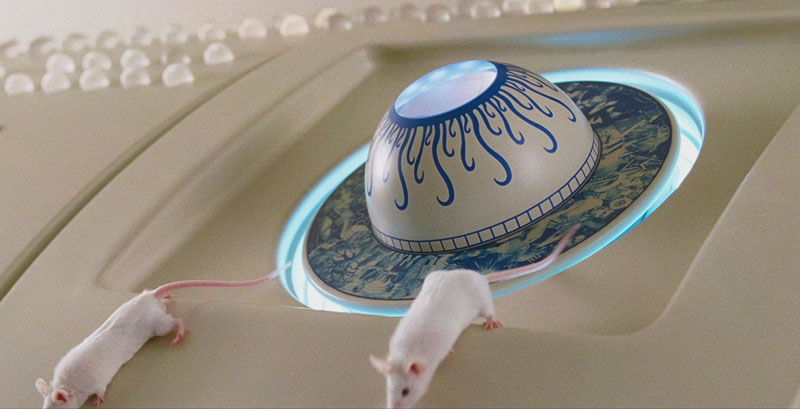
Sorry guys, but this one probably isn’t happening. And by probably, I mean definitely. It’s a fun idea for sure. If you aren’t familiar, the infinite improbability drive was invented by author Douglas Adams for his popular science fiction radio show (and later book series, TV show, and movie) The Hitchhiker’s Guide to the Galaxy. The basis of the infinite improbability drive is as follows: you have two machines, an atomic vector plotter (which is assumed to plot the location of atoms in space) and some type of vaguely described computer system called the Bambleweeny 57 Submeson Brain. Together, these objects form a finite probability drive, which, given the probability of an event happening, can make it actually happen. To make an infinite probability drive, one simply calculates the probability of one suddenly appearing in the room and feeds this probability to the finite probability drive, generating an infinite improbability drive.
The infinite improbability drive itself is slightly more complicated than the finite probability drive, and its actual components aren’t understood at all due to the fact that it is created by a finite probability drive and not actually by a person. However, the method in which it works is somewhat understood. First, the drive uses the fact that it is infinitely improbable that you are in every place in the universe at once to make that actually occur. Once the ship is everywhere, the drive uses a finite probability of the ship existing in a particular place to focus in on that spot, bringing the ship there as the infinite improbability slowly drops back down to one.
Disclaimer: I’m going to completely ignore the likelihood of us actually being able to construct a machine to magically make events occur as Adams describes, and instead focus on the probability aspect. For the record, though, we probably couldn’t build the thing.
Now, for starters, I would like to point out that dropping from an infinite improbability to zero would take infinite time, which would basically make the drive useless even if it did exist. In addition, in order to know the exact probability of an event, I believe it would be necessary to simultaneously know the position and motion vector of ever particle in the universe. Having this information would theoretically enable a person with a very very good computer that had an excellent cooling system to use the laws of the known universe to predict the probability of something happening at any instance in the future.
Probability can only exist to the existence of randomness in the universe. There are some phenomenon that are simply impossible to predict accurately, even with all of the information about the environment prior to the phenomena occurring (this amazing article explains it pretty well). If randomness did not exist, the probability of everything that could possibly happen happening would simply be 1. We might not be able to know exactly what things would happen, but whatever occurred at any point would be the only thing that could have occurred.
Here’s where we run into a problem. In order to make the first calculations with our infinite improbability drive, we would need, as mentioned previously, to have complete knowledge of every particle in the universe (or at least the probability of these particles being in a given state) at the exact moment we began our calculation. Which means that we would need to violate the Heisenburg Uncertainty Principle (which is a whole different issue), but it also means that we would need to get information faster than the speed of light, since we would need to know the exact time at which our particles were acting in a certain manner. Why does this matter, you ask? Because if an object can move faster than the speed of light, then the Bell Theory (the theory that explains why randomness must exist) is invalidated. We then can no longer assume that randomness exists, and the probability of everything goes to one, making an infinite improbability drive impossible. So, unfortunately for you Hitchhiker’s Guide fans out there, you won’t be planet hopping with an infinite improbability drive any time soon, or ever.
However, I will make one concession. It is possible that both randomness and faster-than-light travel exist. The problem here is that logically, randomness should not exist, and if information can travel faster than light we lose evidence for randomness. So, if we violate the Heisenberg Uncertainty Principle and assume that randomness does exist in spite of lack of evidence and assume that information can travel faster than light, then maybe, just maybe, we could find the exact probability of something occurring at any given time. Which still doesn’t solve the problem of building a machine that can somehow manipulate probability to make an event happen, so I stand by my conclusion.
 On the Horizon